The Garage Cabinet Installation Mistake: Why Standard Brackets Aren’t Enough for Heavy Storage
The Garage Cabinet Installation Mistake: Why Standard Brackets Aren’t Enough for Heavy Storage
It’s 2:00 AM. A thunderous crash echoes through your home, vibrating the floorboards and sending the dog into a barking frenzy. You rush to the garage, expecting to find a break-in or a fallen ladder. Instead, you find a scene of structural devastation. Your brand-new garage cabinets – the ones you spent all weekend installing – are lying face-down on the concrete. Shards of plastic brackets are scattered like confetti, and your expensive power tools are buried under a heap of splintered particle board and spilled motor oil.
As a construction professional with over 25 years of experience, I’ve seen this scenario more times than I care to count. My name is Don McNeal, and throughout my career, I’ve transitioned from general contracting to specializing in high-end garage transformations. I’ve seen the “Fear of Screwing Up” (FOSU) manifest in two ways: homeowners who are too afraid to start a project, and homeowners who aren’t afraid enough of the physics involved in heavy-duty storage.
At Artisan Cabinet Workz, I’ve partnered with Monkey Bars systems because I’ve seen what happens when you treat a garage like a kitchen. A garage is not a kitchen. It is a high-stress, high-impact environment subject to temperature extremes, humidity, and loads that would make a kitchen pantry buckle. The single biggest mistake I see? Relying on standard brackets and mounting hardware designed for indoor cabinetry.
The Physics of Failure: Why Kitchen Hardware Fails in the Garage
To understand why cabinets fall, we have to look at the physics of the garage environment. In a kitchen, a standard upper cabinet might hold a stack of ceramic plates, some glassware, and a few boxes of crackers. The total weight rarely exceeds 50 to 75 pounds. In the garage, however, we tend to treat cabinets as vertical warehouses. A single gallon of paint weighs about 12 pounds. A circular saw, a drill set, and a few boxes of 3-inch framing nails can easily push a single shelf over the 100-pound mark.
When you multiply that across four or five shelves, you are looking at a cabinet unit exerting 400 to 600 pounds of “shear force” on the mounting hardware. Shear force is the “sliding” pressure that wants to pull the screw straight down through the wood or snap the bracket in half. Standard plastic clips or thin metal L-brackets are simply not rated for this kind of sustained stress.
Furthermore, the garage is a volatile environment. Unlike the climate-controlled interior of your home, the garage breathes with the seasons. Research into structural integrity shows that humidity swings and temperature shifts cause materials to expand and contract. This cycle “hardens” standard plastics, making them brittle over time, and causes the wood fibers in the cabinet box to swell and loosen around the screws. This is why we recommend plywood cases over particle board for heavy pantry shelves and garage units alike – plywood holds fasteners significantly better under environmental stress.
The “Standard Bracket” Trap
Many homeowners head to the big-box hardware store and buy “heavy-duty” L-brackets, thinking they’ve solved the problem. The trap is that these brackets are often rated for static weight in perfect conditions. They don’t account for the “dynamic” load of a garage – the vibration of the garage door opening, the slamming of a cabinet door, or the accidental bump from a car bumper.
There is also the myth of “it felt tight” during installation. Just because a screw bites into a stud doesn’t mean it’s secure. Garage walls are notorious for being out of plumb (not perfectly vertical). In fact, it’s common for a garage wall to be out of plumb by an inch or more over an eight-foot span. When you screw a flat cabinet back against a crooked wall using standard brackets, you are “pre-stressing” the hardware. You are essentially forcing the bracket to hold the cabinet in a twist, which uses up its load-bearing capacity before you’ve even placed a single screwdriver on the shelf.
While homeowners are often diligent about scheduling residential garage door repair to keep their home secure, they frequently overlook the structural integrity of the walls that hold their heavy storage. A cabinet failure isn’t just a matter of broken tools; it’s a safety hazard for anyone standing nearby, including children and pets.
Reinforced Backing: The Secret to Heavy-Duty Storage
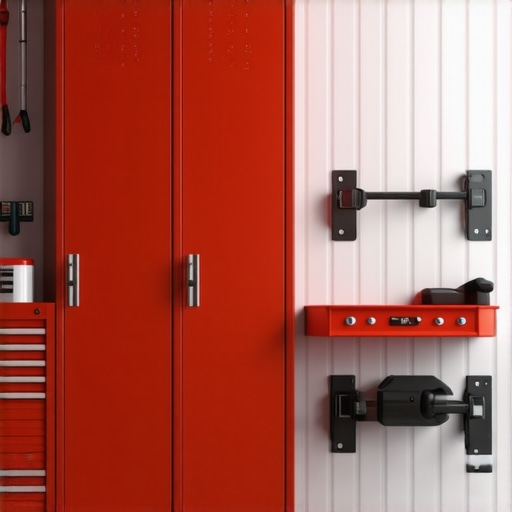
If standard brackets are the problem, what is the solution? The answer lies in reinforced backing and integrated steel mounting systems. Professional systems, like the Monkey Bars systems I install, don’t rely on a few points of contact. Instead, they utilize a horizontal steel rail or a full-width reinforced back panel that distributes the weight across multiple studs.
This approach transforms the cabinet from a box hanging on the wall into an integrated part of the home’s structure. When we talk about heavy-duty storage, we have to consider “pull-out strength.” A standard wood screw in a pine stud has a certain amount of grip. By using multiple points of contact along a steel track, we ensure that the load is shared. This is the same principle we apply in other areas of the home; for instance, we’ve discussed the wall-hung vanity mistake and why you need extra blocking in the studs to prevent the unit from tearing away the drywall.
In the garage, this reinforced backing allows us to hang cabinets off the floor while still maintaining massive weight capacities. It’s a common rule of thumb that heavy items are best stored lower to keep the center of gravity down, but with a steel-reinforced mounting system, the hardware is more than capable of supporting the entire unit’s weight, preventing the “tipping” or “peeling” effect that causes standard cabinets to fail.
Off-the-Floor vs. Floor-Mounted: Choosing Your Base
One of the most debated topics in garage organization is whether to mount cabinets directly on the floor or “float” them off the ground. According to industry data, specifically Mistake #12 from Innovate Home Org, the advice is clear: “Install your cabinets off the ground – or you’ll be sorry.”
In a garage, the floor is a hostile zone. It’s where moisture collects, where pests like crickets and spiders hide, and where road salt and snow melt from your car pool. If you use floor-mounted cabinets without a significant base, the bottom of the cabinet will eventually wick up moisture, leading to rot and structural failure.
However, if you choose to use legs for support, they must be true heavy-duty adjustable legs. These legs must be leveled to account for the garage slab slope – which is typically 1 inch for every 8 feet to allow for drainage. If the legs aren’t perfectly adjusted before the cabinet is loaded, the weight will shift unevenly, putting massive torque on the wall brackets. During these installations, why you should never use standard wood screws for cabinet installation becomes apparent; you need specialized lag bolts or structural screws that can handle the shifting weight of a settling cabinet.
Integrating Storage with Garage Mechanics
A garage isn’t just a room; it’s a machine. It has moving parts, tracks, springs, and sensors. One of the most frequent errors I see in DIY installations is a lack of foresight regarding the garage door’s operation.
When you are planning your cabinet layout, you must account for the “swing” and “track” clearance. I’ve seen beautiful cabinet arrays that completely blocked the access panels for garage door installers or interfered with the safety sensors near the floor. If a cabinet is placed too close to the overhead tracks, the vibration of the door can actually loosen the cabinet’s mounting hardware over time.
Furthermore, if you ever need garage door repair, the technician needs room to work. Crowding the door assembly with deep cabinets can turn a simple repair into a multi-hour ordeal. This is why I always coordinate my storage designs with the mechanical realities of the space. A poorly placed cabinet can lead to a door malfunction, eventually forcing you to call garage door repair companies to fix a problem that was entirely preventable with better planning during the garage door installation phase.
Don McNeal’s 5-Point Installation Checklist
Before you pick up a drill, I want you to run through this checklist. This is the same mental framework I use when I walk into a client’s home to ensure we avoid the “FOSU” and deliver a product that lasts a lifetime.
- Verify Your Studs (The Deep Scan): Don’t trust the “thump” test or a cheap magnet. Use a deep-scan stud finder to locate the exact center of the studs. In many garages, the studs are wider apart than the standard 16 inches, or there may be “floating” studs that aren’t load-bearing. You need to know exactly what you are drilling into.
- Level the Slope: Remember that 1-inch-per-8-foot slab slope. Never assume your floor is level. Use a laser level to establish a horizontal “datum line” across the wall. Mount your cabinets to this line, not to the floor.
- Steel Over Plastic: If your cabinet kit came with plastic brackets, throw them in the recycling bin. Replace them with powder-coated steel brackets or a continuous steel mounting rail. The peace of mind is worth the extra $50 in hardware.
- Clearance Check: Ensure your cabinet depth (typically 24 inches) doesn’t interfere with your vehicle doors or the path of the garage door. Open your garage door and measure the distance from the track to the wall at multiple points.
- Load Mapping: Plan your storage before you install. The heaviest items – generators, floor jacks, bags of concrete – should be planned for the bottom-most reinforced areas. For even more stability, consider the trick to installing heavy upper cabinets without a second pair of hands to ensure everything stays level during the fastening process.
Safety and Longevity
Beyond the structural integrity of the brackets, we have to talk about the safety of what’s inside the cabinets. In my 25 years in construction, I’ve learned that a garage is often the most dangerous room in the house. It’s where we store pool chemicals, pesticides, and flammable liquids.
Referencing Mistake #10 from Innovate Home Org, it is vital to include locks on your cabinet doors. This isn’t just about theft; it’s about protecting children and pets. When a cabinet is properly installed with reinforced steel backing, the doors will stay square and the locks will actually line up. When a cabinet is sagging due to poor brackets, the doors will misalign, rendering locks useless and creating a gap where fumes can escape or curious hands can reach.
We also have to consider specialized storage needs. For instance, if you are planning to store a heavy appliance on a garage workbench or inside a cabinet, you should look at how to reinforce an upper cabinet for a heavy microwave as a baseline for structural reinforcement. The same logic applies to heavy power tool stations.
Conclusion: Professionalism Over “Good Enough”
Transforming a garage from a cluttered mess into a streamlined, organized workspace is one of the most rewarding home improvement projects you can undertake. It changes the way you start and end your day. But that transformation is only as good as the hardware holding it up.
The “Garage Cabinet Installation Mistake” is thinking that “good enough” is acceptable for a high-load environment. Standard brackets, plastic clips, and wood screws might hold for a month, or even a year, but eventually, the physics of the garage will win. Whether it’s the humidity, the weight of your tools, or the vibration of the garage door, weak hardware will eventually fail.
At Artisan Cabinet Workz, my goal is to eliminate that “crash in the night.” I want you to have the confidence that your storage is as permanent as the foundation of your home. By using Monkey Bars systems, reinforced steel mounting, and plywood construction, we ensure that your garage is not only beautiful but also safe and incredibly durable.
If you’re ready to stop worrying about your storage and start enjoying your garage, contact us for a professional consultation. Let’s build something that lasts. We can help you navigate everything from stud placement to ensuring your new layout doesn’t interfere with future garage door repair or garage door installation. Don’t let FOSU keep you from the garage of your dreams – do it right the first time with Artisan Cabinet Workz.