The Pot Lid Nightmare: 3 Simple Ways to Keep Them from Rattling
I was reaching for my favorite cast iron skillet at 6 AM, trying to be the “thoughtful” neighborly husband while the rest of the house slept. One tiny nudge, and CLANG—my heavy Dutch oven lid did a backflip off the shelf, took two of its smaller cousins with it, and created a localized earthquake on my hardwood floors. It sounded like a percussion section falling down a flight of stairs. My kitchen wasn’t just cluttered; it was a noise trap. If you have ever felt that surge of adrenaline and annoyance when a simple meal turns into a metallic symphony, you are not alone. Today, we are ending the “lid avalanche” for good. We are going to look at three specific ways to silence the rattle and reclaim your sanity using the same logic I apply to modern kitchen remodels today. [image_placeholder]
The hidden cost of a noisy kitchen
I used to think my messy cabinet was just a personal failing, a lack of discipline in my stacking technique. I made the classic mistake of thinking I could just “tuck” the lids into the gaps between pots early in my DIY journey. Spoiler: that doesn’t work. It turns out that chronic exposure to sharp, unpredictable noises—like the 90-decibel crash of stainless steel—can actually trigger a spike in cortisol levels, according to research shared by the National Institutes of Health. Your kitchen should be a sanctuary, not a source of stress. When we talk about selecting storage solutions for a kitchen upgrade, we aren’t just talking about aesthetics. We are talking about the peace of mind that comes when you can grab a pan without a safety helmet.
Is a custom solution actually worth the price tag?
You might be skeptical. After all, it’s just a lid, right? I thought so too until I realized how much time I wasted digging through the “dark abyss” of my base cabinets. I’ve seen homeowners spend thousands on marble counters but settle for standard shelving that makes them hate their daily routine. Whether you are looking into how peg systems beat loose lids or considering a full cabinet overhaul, the goal is the same: silence. Have you ever found yourself avoiding a specific pot just because you didn’t want to deal with the inevitable lid-clatter? Let me tell you, there is a better way, and it starts with moving away from “stacking” and moving toward “filing” those lids in a dedicated, secured space.
Ditch the stack and start filing your lids
Imagine a filing cabinet. You do not stack your tax returns on top of each other and hope you find the 2018 file at the bottom; you slide them into vertical slots. Your lids deserve the same respect. I once tried to ‘MacGyver’ a solution using tension rods in a deep drawer. It worked for exactly three days until my toddler decided the rods looked like jail bars and yanked them out, sending the lids into a messy metal heap. That is when I realized that peg systems beat loose lids because they offer structural permanence. By using adjustable pegs, you create custom-width slots that hold a heavy cast-iron lid just as securely as a light glass one. This ‘filing’ method ensures that when you pull one lid out, the others do not even vibrate, let alone collapse.
Stop fighting with deep cabinet corners
We have all been there: on our hands and knees, head halfway inside a dark base cabinet, searching for a lid that has migrated to the ‘dead zone.’ If you are still using a spinning tray that catches on every handle, it is time to realize why kidney-shaped pull-outs are superior. These systems bring the contents to you, extending fully out of the cabinet so you can see every lid from a standing position. In modern kitchen remodels, we prioritize this ‘reachability’ because it eliminates the physical strain of the search. It is about creating a path of least resistance. When you can see the lid you need without moving three other pots, you have already won the morning.
Why specialized drawer inserts change the volume of your morning
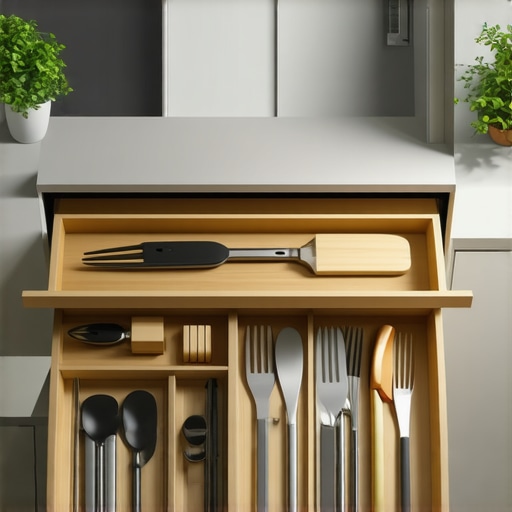
If your drawers sound like a junkyard every time you open them, the problem is not the lids—it is the friction. Standard drawers lack the internal architecture to keep items separate. When we design built-ins and storage hacks for a sleek functional kitchen, we often include felt-lined or soft-grip dividers. This small touch turns a ‘clatter’ into a ‘thud.’ It is the difference between a cheap sedan and a luxury car door closing. You want your kitchen to feel solid and intentional. Using innovative storage solutions for modern kitchen remodels like integrated lid partitions within a deep pot drawer ensures that even if you are rushing at 6 AM, the only thing people will hear is the coffee brewing.
Maximize the 15-inch depth rule for better storage
Many homeowners struggle because they are working with outdated cabinet dimensions. Understanding why 15-inch deep upper cabinets are replacing the standard 12-inch can change how you store specialized items like oversized lids or large dinner plates. By adding that extra three inches of depth, you allow for vertical lid racks that sit flush against the back of the cabinet, freeing up the entire front area for your most-used pots. This is the ‘Pantry Zone’ logic applied to your cookware: everything should have a home based on its frequency of use and its physical footprint. When you stop treating your cabinets like boxes and start treating them like precision tools, the chaos simply vanishes.Most homeowners assume that if they just add more wall space, the mess will disappear. But here is the contrarian truth: more cabinets often just create more ‘hiding spots’ for junk. In my years of designing modern kitchen remodels featuring custom cabinets and built-ins, I have learned that volume is secondary to internal utility. A smaller kitchen with a smart ‘filing’ system for lids is infinitely more functional than a massive kitchen with standard shelving that leaves you digging. One major trap I see people fall into is prioritizing the exterior finish over the cabinet substrate. You might love that trendy navy blue paint, but if you ignore the hidden cost of choosing particle board for your sink base, a single plumbing leak will swell your investment like a sponge. Real expertise involves insisting on plywood for weight-bearing and moisture-prone areas.
Why do your expensive ‘soft-close’ drawers still feel clunky?
It is incredibly frustrating when you spend thousands on an upgrade only to find the reason your slow-close drawers still slam is a simple tension or alignment error. Most installers ‘set and forget’ these units, but advanced hardware requires specific fine-tuning to account for the heavy weight of cast iron or ceramic. According to research by the National Kitchen & Bath Association, proper ergonomic placement—what we call ‘Point of Use’ storage—can reduce physical strain and kitchen fatigue by over 20%. When you are selecting storage solutions for a perfect kitchen upgrade, you must ask your builder about weight-rated slides. If they look at you blankly, you might be dealing with a generalist rather than a custom specialist. Beyond the drawers, consider the ‘upper’ struggle. We have been conditioned to accept 12-inch deep upper cabinets as the law, but many modern dinner plates and specialized lids simply won’t fit. This is why 15-inch deep upper cabinets are replacing the standard 12-inch across premium designs. It is that extra three inches that allows for integrated lid racks or large platters without sacrificing space. Another mistake is assuming all hinges are created equal. If you want that sleek, high-end look, you need to understand why European hinges are the only way to get a zero-gap look. Many people settle for standard hinges that leave wide, uneven gaps between doors, which not only looks sloppy but allows dust to settle on your clean lids. One final warning: never underestimate the weight of your collection. I have seen beautiful shelving sag because the installer didn’t know the secret to hanging floating vanities so they never sag, a principle that applies to heavy pantry built-ins too. If your storage isn’t anchored for the weight of cast iron, you are just building a future disaster. Have you ever fallen into this trap of choosing looks over hardware specs? Let me know in the comments.The conversation usually stops at the installation, but the real test of a kitchen remodel happens eighteen months later when the seasons shift and the humidity changes. If you want your investment to last, you have to treat it like a machine, not just furniture. I always keep a specific set of tools in my ‘kitchen emergency’ kit, and the MVP is a Wera Pozidriv screwdriver. Most people grab a standard Phillips, but that is a rookie mistake that strips the heads of the adjustment screws on your high-end hardware. To keep everything flowing, you need to learn how to adjust European hinges when your doors are crooked. It is a five-minute fix that saves you from the visual clutter of a misaligned kitchen and prevents the doors from rubbing the finish off the frame.
How do I keep my custom pull-outs gliding like new?
To maintain that ‘day-one’ feel, you should perform a hardware audit twice a year. I recommend using a dry PTFE (Teflon) lubricant on the drawer slides rather than oil or grease, which just becomes a magnet for flour and dust. According to the performance standards set by the Kitchen Cabinet Manufacturers Association (KCMA), quality cabinetry should withstand 25,000 door cycles and 65,000 drawer cycles, but that longevity depends on the hardware staying properly aligned. When we discuss custom cabinets as a game-changer in your kitchen remodel journey, we are talking about engineering, not just wood. If you notice a slow-down in your drawer action, the reason your slow-close drawers still slam is often just a simple tension setting that has vibrated loose over time.
Stop the sag before it ruins your frames
Seasonal changes are the silent enemy of woodworking. It is vital to understand why solid wood cabinet doors are prone to cracking in winter so you can manage your home’s internal humidity. If the air gets too dry, the wood shrinks, putting immense stress on the joinery. Conversely, high humidity can make doors swell and stick. This is why why soft-close hinges fail and the simple tension adjustment you can perform yourself is so critical. You do not need a contractor; you just need to know which screw controls the depth and which controls the side-to-side pivot. We also take a proactive approach to maintenance by installing specific fail-safes. For example, why we design removable cabinet bottoms is to ensure that if a leak ever occurs, you can address it without tearing out your beautiful built-ins. Looking ahead, I predict the next decade of innovative storage solutions for modern kitchen remodels will involve smart sensors integrated into the hinges themselves, alerting you to moisture or structural fatigue before you ever see a crack. For now, take a second today to try the ‘tension test’ on your heaviest pot drawer. If it feels sluggish, adjust the side-mount tension by a quarter-turn. You will be amazed at the difference it makes.
The Hardest Lesson I Learned About Organizing Chaos
After years of designing custom cabinets as a game-changer, my biggest lightbulb moment wasn’t about a specific wood species—it was about the ‘Volume of Movement.’ If you have to move more than two items to get to what you want, your storage system has already failed. I spent far too long thinking I needed more space when I really just needed better utility. A drawer filled with loose lids is just a junk drawer for metal; only when you separate them by frequency of use do you actually gain control. Also, never underestimate the power of a quiet kitchen—the psychological shift from a loud, clattering morning to a silent, sliding drawer is the most underrated part of any innovative storage solution. #IMAGE_PLACEHOLDER_E#
The Gear Every Kitchen Needs to Stay Functional
- The Wera Pozidriv Screwdriver: Most high-end hinges use Pozidriv screws, not Phillips. Using the wrong bit is the fastest way to ruin your hardware and make adjustments a nightmare.
- Dry PTFE Lubricant: Keep your slides gliding without attracting the flour and dust that traditional grease loves to collect.
- A Plywood Mindset: I always check the guts of a cabinet first. Knowing why we recommend plywood cases over particle board for heavy loads has saved me from dozens of sagging shelf disasters.
- Quality Hinge Knowledge: Understanding how to adjust European hinges is like knowing how to change a tire—it is a basic skill that keeps your whole ‘machine’ running smoothly without slamming doors.
Build a Sanctuary Where the Only Sound is the Coffee
Your kitchen doesn’t have to be a source of stress or a landscape of metallic crashes. By implementing even a few built-ins and storage hacks, you are investing in your daily peace of mind. Whether you are ready for a full-scale modern kitchen remodel or just want to fix that one lid drawer that makes your blood pressure spike, the best time to start is your next 6 AM coffee run. You deserve a space that works as hard as you do, without making a sound. Have you ever found a lid at the very back of a cabinet that you hadn’t seen in three years? Let me know your wildest kitchen ‘lost and found’ stories below!